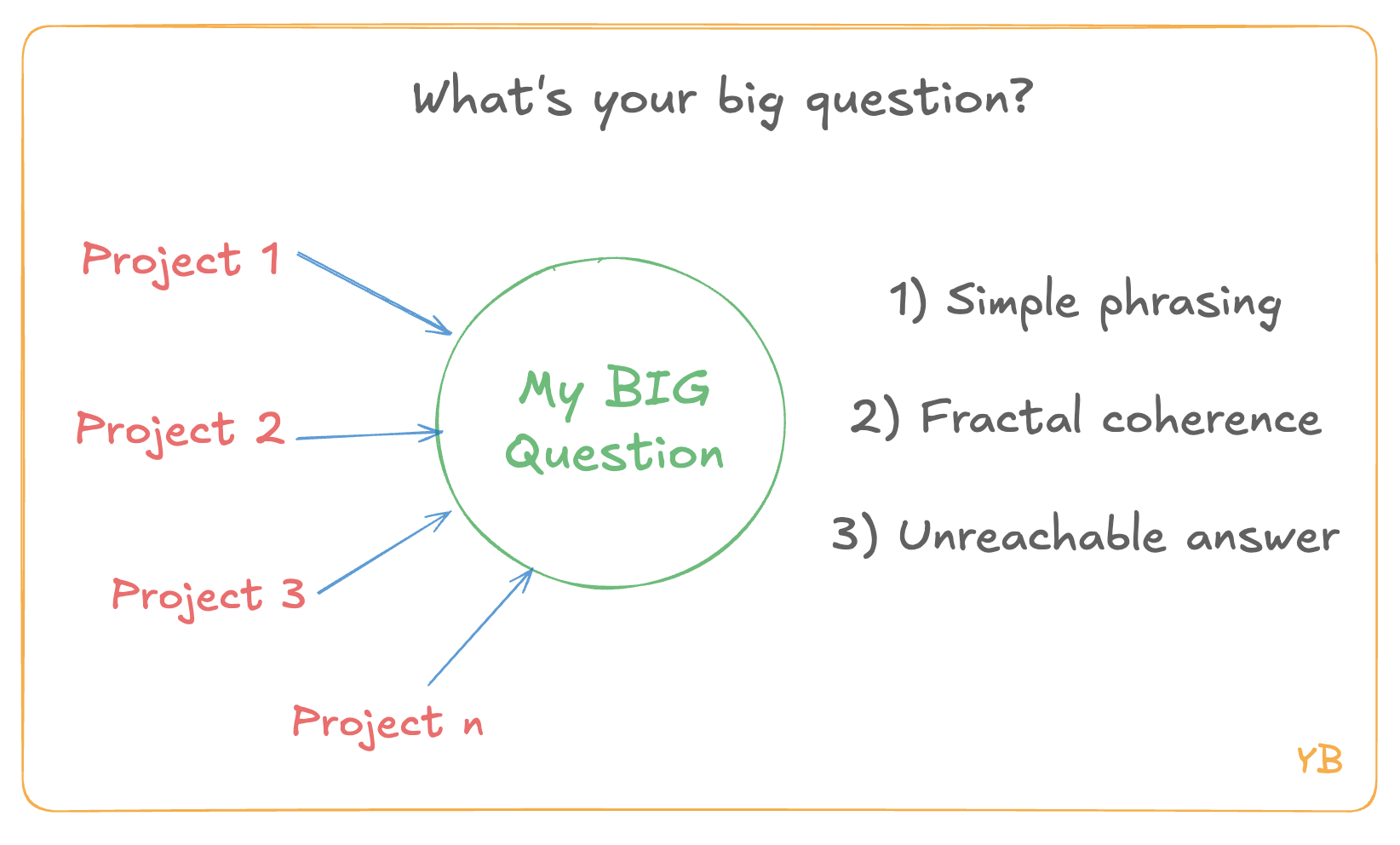
What's your big question?
The common thread in your work

I recently listened to Jack Altman interview Dwarkesh Patel on the Uncapped podcast.
There was one section halfway through the episode that stood out to me.
Jack: What domains are you most interested in right now? Because I feel like I’ve seen you talk about politics in Russia, math & science, and longevity. What are you interested in most right now?
Dwarkesh: I’m interested in what the year 2050 looks like.
This answer by Dwarkesh made it clear to me as to why he’s thriving as creator: there’s an overarching question that is driving his reading and research.
Most people, including myself, tend to focus on everything but the big question that fuels our intellectual curiosity.
We know what topics we like. We know how often we want to release a post / episode. We have a list of dream guests we want to have conversations with. And we know what subjects and themes the rest of tech twitter will like.
But we can’t articulate why we’re putting in all this effort! What is the problem statement or question that is the common thread in our work?
In the book Facebook: the inside story, Stephen Levy spends the first couple of chapters covering all the projects Zuckerburg worked on before Facebook.
Finally, on page 61, Levy makes it clear that Facebook was not an accident. Zuckerburg had been trying to solve how people could share information on the internet long before thefacebook.com was launched in 2003…it was only a matter of time before one of his side quests took off.
The common thread of all those projects, Zuckerburg would later explain, was his belief that with the internet we now had the means to more efficiency share information
My point with providing both of these examples above is that it’s essential to have an overarching question that ties all your work together.
There needs to be a thread that weaves through your research, writing, conversations, scratchpad, tweets, and so on. Without it, you’ll feel like a robot endlessly checking off action items until you eventually look up and realize you have no idea what you’re working on.
Just for fun, I asked ChatGPT to craft the big picture questions for some of my favorite creators.
Tim Urban: Why do humans and society think, act, and evolve the way they do?
Shane Parrish: How can we think better so we can live better?
Packy McCormick: How do technology and business shape the future, and how can we find the stories that make it exciting?
Lenny Rachitsky: How do you most effectively build and grow products, teams, and companies?
After some back and forth with GPT, I realized that all big picture questions have three consistent properties:
Simple phrasing - you can wrap decades of work into a single sentence
Fractal coherence - you can zoom in and out on the question as much as you want
Unreachable answer - you can’t draw a box around the solution
I’m not at a point where I can definitely say what my overarching question is. But I did take some time to brainstorm and come up with a v1.
How can we ensure humans maintain the most agency over their lives as technology rapidly transforms everything?
Over the next few months (years?), I’ll work on “perfecting” my overarching question until I know for a fact that I want to spend the upcoming decades of my life searching for the answer.